
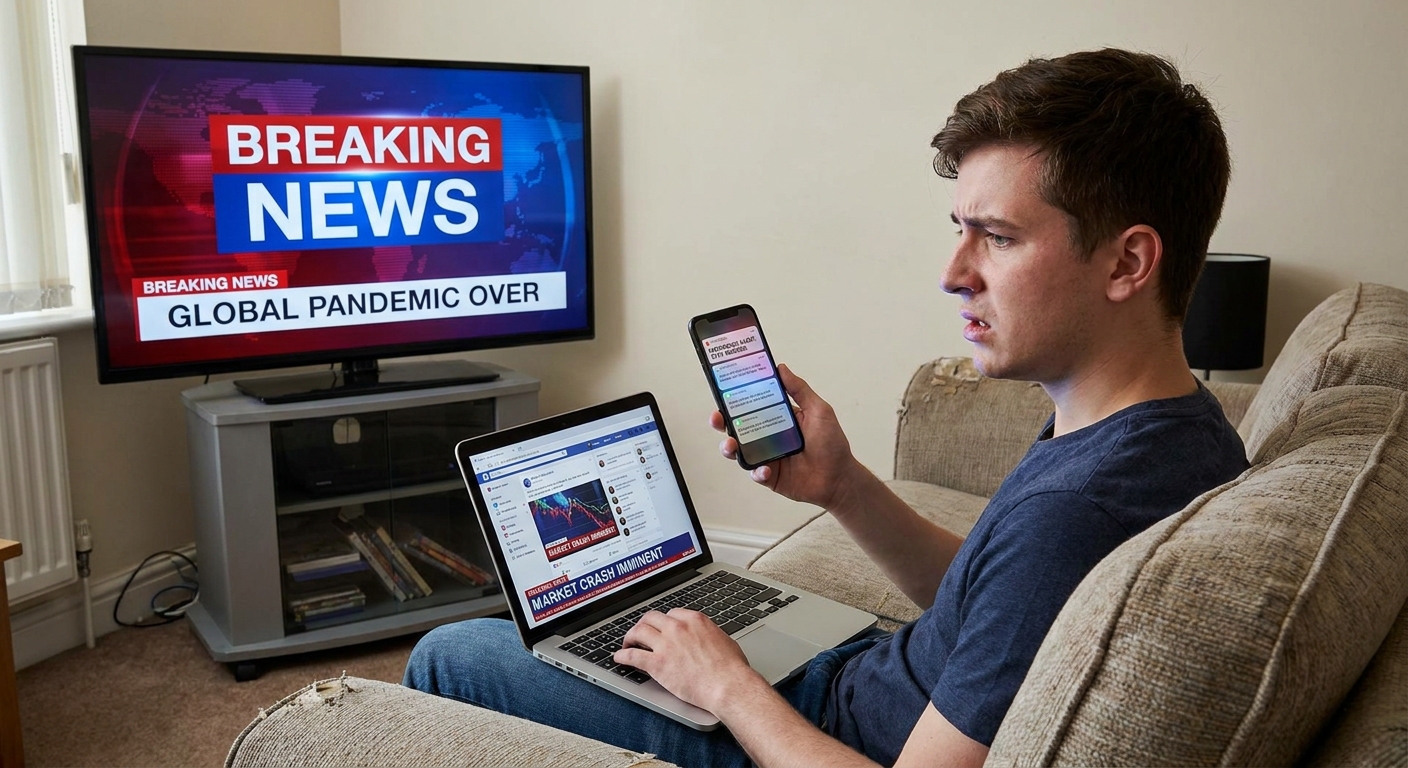
Your Breaking News Options Aren’t Equal
When something major happens, you’re typically hit from three directions:
- Cable news banners
- Social media feeds
- Push alerts from apps
They all scream *breaking*. They’re not equally reliable.
“Each system has its own speed-accuracy tradeoff baked in,” says Dr. Malik Herrera, who studies news ecosystems at Northeastern University. “If you treat them as interchangeable, you’ll be wrong as often as you’re right.”
Here’s a direct comparison to help you choose what to trust **and when**.
---
Round 1: Speed
**Cable News**
- Fast once the event crosses a certain threshold
- Dependent on assignment desks and satellite hookups
- Often 10–30 minutes behind the earliest social media posts
**Social Media**
- Instant from eyewitnesses and insiders
- Zero editorial friction — anyone can post anything
- Often *too* fast for any verification
**Push Alerts** (from major outlets)
- Triggered after at least minimal confirmation
- Delayed compared to social but faster than full articles
- Typically 5–20 minutes after first internal newsroom alerts
**Winner on speed:** Social media. **Winner on useful speed:** Push alerts.
---
Round 2: Accuracy in the First Hour
**Cable News**
Strengths:
- Professional editors and legal teams
- Direct access to officials and correspondents
Weaknesses:
- Pressure to fill airtime with speculation
- “Panel” culture that blurs news and opinion
Accuracy record:
- Solid on *whether* something happened
- Spottier on early casualty counts, motives, and suspect IDs
**Social Media**
Strengths:
- Raw on-the-ground vantage points
- Niche experts (e.g., OSINT, domain specialists) sometimes beat newsrooms
Weaknesses:
- Incentives for clout, not correctness
- Bots, parody, and propaganda mixed with reality
Accuracy record:
- Extremely uneven; some posts are gold, most are noise
**Push Alerts**
Strengths:
- Condensed, carefully lawyered facts
- High internal bar for sending alerts; reputations at stake
Weaknesses:
- Very limited context
- Can oversimplify complex events into one line
Accuracy record:
- Generally high on core facts, lower on nuance
**Winner on first-hour accuracy:** Push alerts, then cable, then social.
---
Round 3: Depth and Context (Within 24 Hours)
**Cable News**
Pros:
- Live access to officials, analysts, affected communities
- Visual explainers, maps, and timelines
Cons:
- Repetitive coverage loops
- Hosts and commentators inserting strong frames
**Social Media**
Pros:
- Domain experts explaining technical details (e.g., aviation, cybersecurity)
- Affected locals sharing granular realities missed by national TV
Cons:
- Hard to separate genuine expertise from self-branded “experts”
- Algorithm “rage boosts” extreme takes
**Push Alerts**
Pros:
- Great at flagging major developments (indictments, resignations, new data)
Cons:
- Poor at explaining *why* developments matter
- Can cause a fragmented story in your head without a full read-through
**Winner on depth (if you choose carefully):** Cable *and* curated social, tied.
---
Round 4: Manipulation Risk
**Cable News**
- Risks: framing, story selection, and guest choice shaped by owner and audience politics
- Less risk of outright fabricated facts due to legal exposure
**Social Media**
- Risks: bots, paid trolls, state-backed psyops, coordinated hashtag campaigns
- Synthetic media (deepfakes, edited clips) getting harder to detect
**Push Alerts**
- Risks: editorial bias in what’s considered “alert-worthy”
- Word choice can still subtly frame events
“Social media is the easiest to weaponize at scale,” Herrera says. “Cable shapes perception more slowly but with a bigger hammer. Push alerts are quieter but still framed choices.”
**Winner on lowest manipulation risk for raw facts:** Push alerts.
---
How to Use Each Stream Without Getting Burned
Best Use of Cable News
- Turn it on **once the story is confirmed** to get live briefings and visuals.
- Mute panels focused on early blame or partisan framing.
- Flip between at least two networks to spot framing gaps.
Watch for:
- When anchors clearly label speculation vs. confirmed info
- Whether they show full pressers or cherry-picked clips
Best Use of Social Media
- Use it as a **sensor**, not a verdict.
- Build a pre-curated list of:
- Local reporters in key cities
- Known OSINT and verification experts
- Domain specialists (aviation, security, law, markets)
- Keep that list separate from your main feed.
Avoid:
- Viral anonymous accounts with no track record
- Hashtags that appear minutes after an event with clear political branding
Best Use of Push Alerts
- Treat them as **headlines that tell you what to investigate**, not your full understanding.
- Subscribe to 2–3 outlets with different sensibilities (e.g., one global wire, one national, one local).
- If two alerts conflict, click through before forming an opinion.
---
What to Watch Next: Hybrid Models and AI Filters
News consumption is shifting toward hybrids:
- **Live blogs** that combine the speed of social with newsroom verification
- **AI-assisted verification tools** checking images, locations, and timelines
- **Curated feeds** inside messaging apps and newsletters
“The next few years will be about layering smart filters on chaotic streams,” Herrera predicts. “The winners will be users who know what each stream is good for — and what it isn’t.”
In the next breaking moment, don’t ask which source is “best.” Ask:
- What do I need **right now** — speed, certainty, or depth?
- Which stream is optimized for that job?
Then use it on purpose, not on autopilot.