
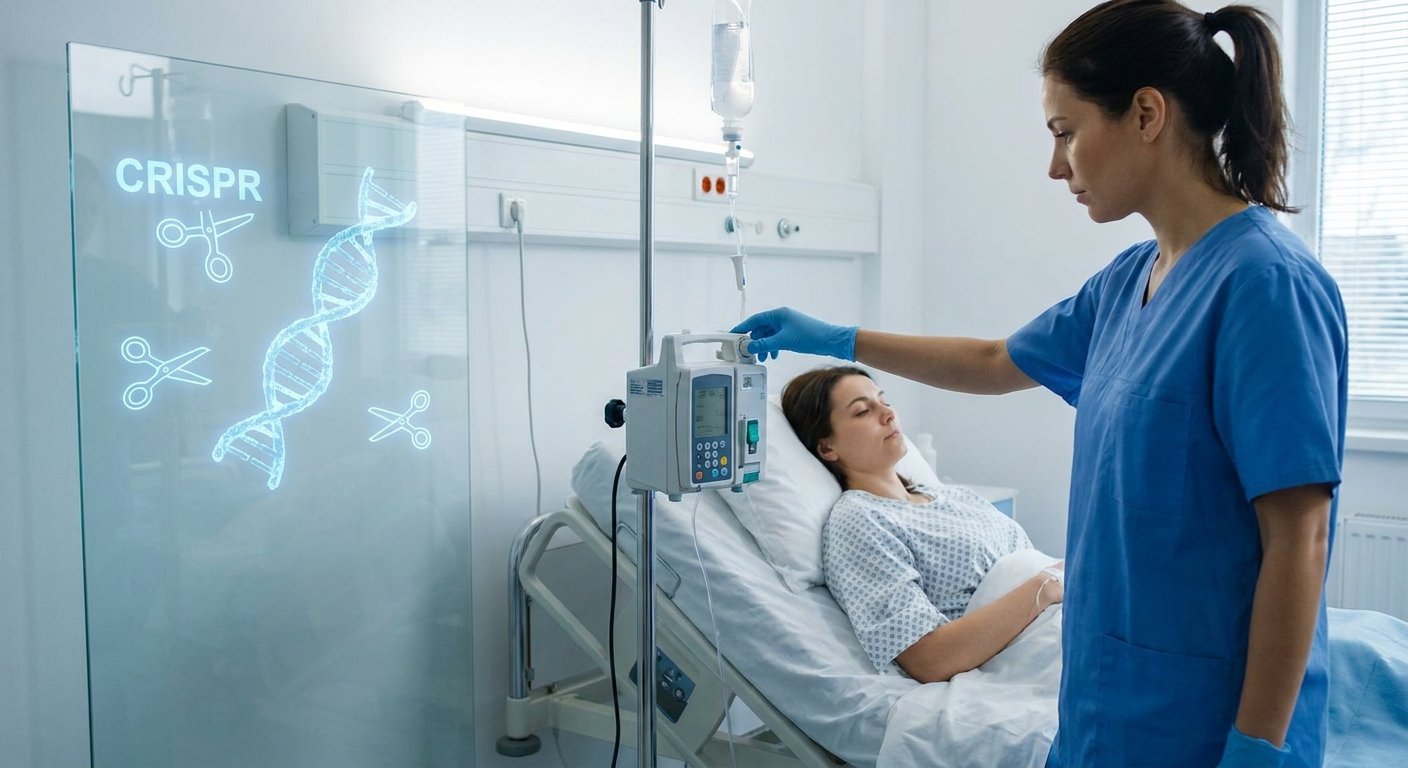
CRISPR Leaves the Hype Cycle
A decade ago, CRISPR was pitched as the magic scissors that would let us rewrite life at will. Today, the marketing buzz has faded — and the real work has started.
The gene-editing tool is now moving through clinical trials, regulatory gauntlets, and hospital pipelines. No longer a lab curiosity, it’s becoming **infrastructure**.
> “We’ve gone from ‘can we edit genes?’ to ‘how, where, and who pays for it?’,” says Dr. Fyodor Urnov, a gene-editing pioneer. “That’s a very different conversation.”
Here are seven concrete, trackable ways CRISPR and its cousins are rewiring medicine **right now**.
---
1. Curing Single-Gene Blood Disorders
Target: **Sickle-cell disease and beta-thalassemia**
These conditions are caused by well-understood mutations in hemoglobin genes — a near-perfect testbed for gene editing.
What’s happening:
- Ex vivo CRISPR therapies remove blood stem cells from the patient.
- A CRISPR system edits regulatory DNA to **reactivate fetal hemoglobin**, which doesn’t sickle.
- The edited cells are infused back after chemotherapy clears room in the bone marrow.
In late-stage trials, many patients became effectively free of severe crises.
Why it matters:
- Proof that a **one-time gene edit** can reset a lifelong disease trajectory
- A blueprint for tackling **other monogenic disorders**
What to watch:
- Long-term safety data: off-target edits, cancer risk
- Cost and access: early price tags are in the low **millions per patient**
---
2. Making CAR-T Cancer Immunotherapy More Accessible
Target: **Leukemia, lymphoma, and beyond**
CAR-T therapy reprograms a patient’s T cells to attack cancer. It works — but it’s slow and expensive.
CRISPR’s role:
- Creating **“off-the-shelf” universal CAR-T cells** from healthy donors by editing out immune markers that cause rejection
- Engineering T cells that are **resistant to exhaustion** and immune suppression
- Multiplex editing: knocking out several genes in one go to reduce manufacturing steps
> “Our goal is to turn bespoke cell therapy into a standardized drug,” says a recent *Nature Medicine* editorial on allogeneic CAR-T.
What to watch:
- Early trials of universal CAR-T in solid tumors (lung, pancreatic, ovarian)
- Whether CRISPR-edited cells show **unexpected behaviors** in complex tumor environments
---
3. In Vivo Editing: Taking CRISPR Directly into the Body
The most ambitious move: skip the cell-removal step and **edit cells inside the patient**.
Example targets:
- **Liver diseases** – Inject CRISPR packaged in lipid nanoparticles that home to liver cells
- **Inherited blindness** – Deliver CRISPR to retinal cells with viral vectors
Success here would:
- Simplify treatment logistics massively
- Expand reach to tissues that can’t be easily harvested ex vivo
Risks are higher:
- Less control over which cells get edited
- Immune reactions to delivery systems
- Harder to reverse if something goes wrong
Regulators are moving cautiously — but not slowly. Early in vivo trials for a rare liver condition (transthyretin amyloidosis) have already reported **substantial drops in toxic protein levels**.
---
4. Base and Prime Editing: Fixing DNA with a Surgeon’s Touch
Classic CRISPR cuts both strands of DNA — which can be messy.
Enter **base editing** and **prime editing**:
- **Base editing** swaps one DNA letter for another without cutting both strands.
- **Prime editing** uses a guided “word processor” to write short new sequences into the genome.
Impact:
- Lower risk of large deletions or rearrangements
- Better suited for diseases caused by **single-letter mutations** (of which there are many)
> “Most disease-causing variants are single-base changes,” notes Dr. David Liu, who helped invent base and prime editing. “If we can fix those precisely, we can, in principle, address a huge catalog of conditions.”
Clinical translation is starting slowly, but expect base editors to hit trials for **cholesterol disorders, liver diseases, and eye conditions** first.
---
5. CRISPR for Diagnostics, Not Just Treatment
Editing grabs the headlines, but **CRISPR as a sensor** might end up touching more lives.
Platforms like SHERLOCK and DETECTR repurpose CRISPR proteins that, once triggered by a target sequence, start chopping up signal molecules.
Use cases:
- **Rapid virus detection** (SARS-CoV-2, Zika, dengue)
- Low-cost tests for **antibiotic resistance genes**
- Field-deployable diagnostics where lab infrastructure is weak
Advantages:
- No need for complex thermal cycling (unlike PCR)
- Potential for **paper-strip style readouts**
What to watch:
- Regulatory approvals for CRISPR-based tests as standard-of-care diagnostics
- Integration into **point-of-care devices** and telemedicine kits
---
6. Tackling High-Cholesterol at the Genetic Source
Target: **PCSK9**, a gene involved in cholesterol regulation.
Current drugs like monoclonal antibodies and siRNAs already neutralize PCSK9 — but they require repeated dosing.
CRISPR twist:
- A one-time shot to **permanently dial down PCSK9** activity in liver cells
- Animal studies and early-phase human trials show **dramatic, durable LDL reductions**
If safety pans out, this becomes a **preventive cardiology tool**:
- Treat high-risk patients once
- Potentially delay or prevent heart attacks and strokes years later
The bigger story: moving gene editing from rare diseases into **widespread chronic disease prevention**.
---
7. Editing the Microbiome Instead of Human DNA
Not all gene editing has to touch our own genome.
Emerging strategies aim CRISPR at the **bacteria living in and on us**:
- Knock out antibiotic resistance genes in gut microbes
- Delete toxin genes in harmful strains
- Boost beneficial metabolic pathways in friendly bacteria
> “Think of it as precision gardening for the microbiome,” says a 2024 review in *Cell Host & Microbe*.
Why it’s attractive:
- Edits are **indirectly therapeutic** — tweak the ecosystem, not the patient’s chromosomes
- Potentially reversible and more controllable
Watch for early trials in **recurrent C. difficile infection, inflammatory bowel disease, and metabolic disorders**.
---
The Hard Problems: Cost, Equity, and Governance
The technical curve is steep and climbing. The socioeconomic curve is worse.
Key friction points:
- **Cost** – First-wave CRISPR therapies are seven-figure procedures.
- **Infrastructure** – Many regions lack facilities for cell handling and safe infusion.
- **Ethics** – Somatic editing (non-heritable) is becoming normalized, but germline editing remains a red line in most jurisdictions.
Global bodies like WHO and national academies are pushing for **shared registries, trial transparency, and international norms**.
The near-term reality: CRISPR will first transform care for a **small number of patients in well-resourced systems**. The policy question is whether it then trickles down — or hardens into a genomic divide.
---
What to Watch Next
If you want to track whether CRISPR is actually reshaping medicine — not just headlines — watch these signals:
1. **Regulatory approvals** for the first in vivo CRISPR drugs
2. **Real-world outcome data** on sickle-cell and beta-thalassemia patients 5–10 years post-treatment
3. Expansion of **insurance coverage and reimbursement models**
4. Entry of CRISPR-based therapies into **non-rare, high-burden diseases** (cholesterol, heart disease, diabetes)
5. International moves on **germline editing governance**
The technology is maturing out of the hype phase. The next decade decides whether gene editing becomes a niche miracle — or a standard tool in the medical kit.