
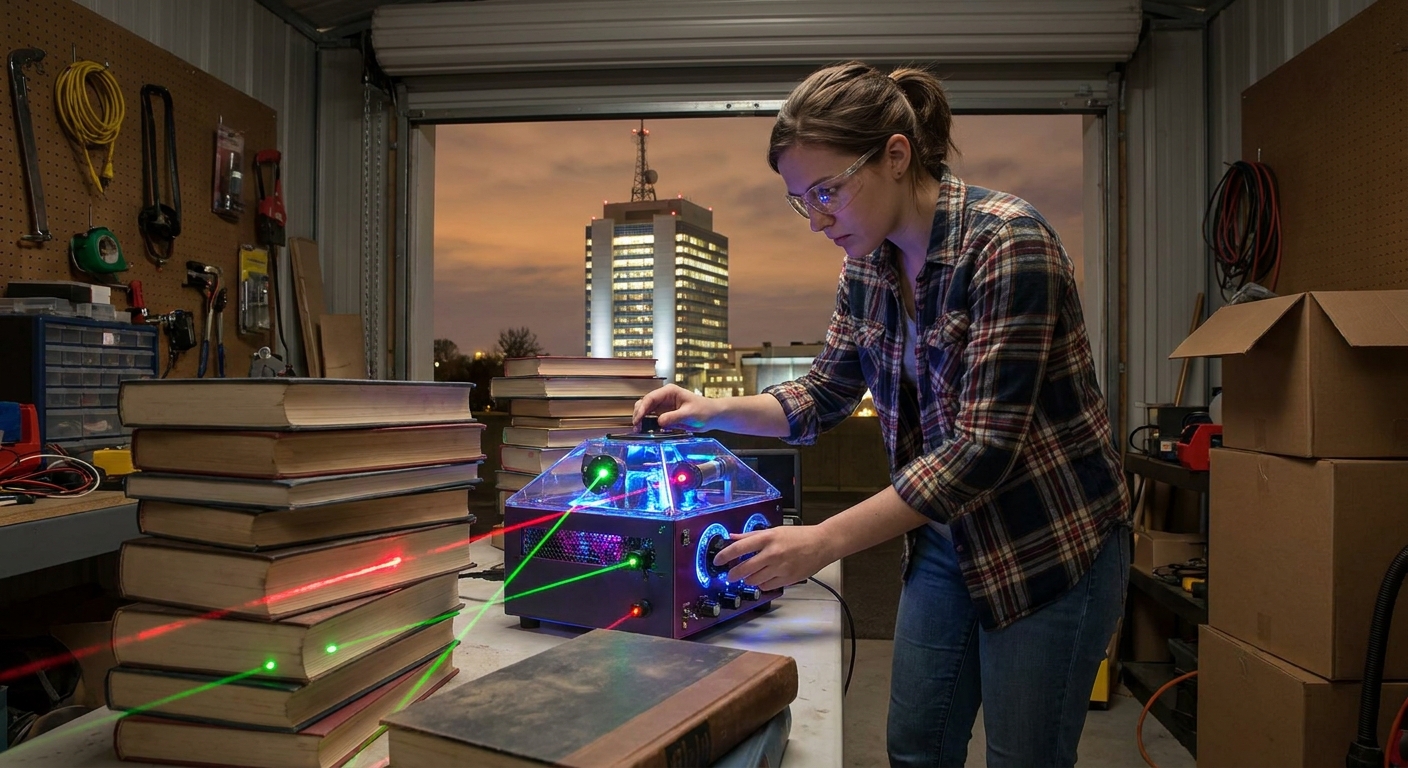
The Quiet Revolt in Experimental Science
For a century, cutting-edge physics meant billion-dollar machines and continent-scale collaborations. Now, a different story is emerging: small, fast, brutally precise **tabletop experiments** are pushing into territory once reserved for particle colliders and space telescopes.
This isn’t a budget consolation prize. It’s a strategic pivot.
> “We’re seeing precision beat brute force,” says Dr. Surjeet Rajendran, theoretical physicist at Johns Hopkins (commenting on the broader field). “You can probe new physics in a basement lab if you know exactly what to measure.”
From testing dark matter to redefining time itself, compact experiments are quietly redrawing the map of what *big* science looks like.
---
Why Tabletop Experiments Suddenly Matter
Three trends lit the fuse:
1. **Hyper-precise instruments**
Atomic clocks that lose one second in the age of the universe. Interferometers that detect motion smaller than a proton. Cheap, ultra-stable lasers. These tools let small labs measure absurdly tiny effects.
2. **Theoretical “blind alleys” at colliders**
The Large Hadron Collider found the Higgs — and then... mostly silence on new physics. Null results are valuable, but they’ve pushed theorists to look for more subtle phenomena: ultra-light particles, feeble forces, tiny symmetry violations.
3. **Democratization of hardware**
Off-the-shelf vacuum systems, photonics kits, FPGA control boards, open-source analysis pipelines. Things that once took custom engineering now ship in a crate.
The result: a new kind of high-impact experiment that fits in a room, not a ring under Switzerland.
---
Case Study: Dark Matter, Now in Desktop Size
We still don’t know what dark matter is. But the search is changing shape.
- **Old paradigm:** Build huge detectors in mines or under mountains; wait for a heavy particle to smack into your sensor.
- **New paradigm:** Hunt for **ultra-light dark matter** with exquisitely tuned tabletop setups.
Examples:
- **Atomic interferometers** – Measure tiny shifts in atomic energy levels that hypothetical dark matter fields would cause.
- **Precision torsion balances** – Look for impossibly small deviations in gravity or new forces.
- **Optical cavities** – Trap light in mirrored boxes and monitor its behavior for subtle distortions.
> “If dark matter is a very light field, it might look less like bullets and more like a background ocean,” notes one review from *Reviews of Modern Physics*. “You don’t need a fortress — you need a very good thermometer.”
This approach opens the game to more players. A mid-scale university lab can now probe parameter space once reserved for nation-state projects.
---
The Atomic Clock Arms Race
Tabletop, but make it existential: **Who keeps the best time, wins the future.**
Modern optical atomic clocks are so accurate they can:
- Sense tiny changes in **gravitational potential** over centimeters (testing general relativity on a lab bench)
- Monitor subtle shifts that could reveal **drifts in fundamental constants**
- Synchronize global navigation and communication at previously absurd precision
In 2022, teams demonstrated clocks that would take longer than the age of the universe to drift by one second.
Why it matters:
- **Physics:** Any deviation in tick rates over time or location could hint at new fields or forces.
- **Tech:** Next-gen GPS, financial networks, and quantum communications all ride on clock stability.
> “These clocks are not just better watches,” emphasizes Dr. Jun Ye, a leading atomic clock researcher. “They are sensors for the universe.”
Expect tabletop clock experiments to become frontline tools in testing dark energy, dark matter couplings, and quantum gravity models.
---
From Colliders to Cavities: A Shift in Risk Profile
Big science was built on **singular bets**: one collider, one telescope, one fusion reactor.
Tabletop science flips the script:
- **Many cheap, parallel bets** instead of one monstrous project
- Faster
**iteration cycles** — design, build, measure, fail, repeat in months, not decades
- Lower barrier to entry for **new labs, new countries, and young PIs**
Downside: more noise.
- Increased risk of **subtle systematics** (tiny experimental biases) masquerading as discovery
- Greater need for **independent replication** across labs
But that’s a solvable problem — and a familiar one. Metrology (the science of measurement) has been quietly doing this quality-control game for 150+ years.
---
What This Means for Funding and Careers
The shift to tabletop-scale doesn’t mean the end of mega-projects. It means the ecosystem is diversifying.
For funders
- High-impact experiments at **one to two orders of magnitude lower cost**
- Ability to fund **portfolios of risk**, not just one flagship
- More room for **high-risk, high-reward ideas** that don’t justify a billion-dollar machine
For early-career scientists
- A viable path to **owning a world-class experiment** earlier in a career
- More creative control over design and direction
- Faster feedback loops: you don’t wait 15 years for first data
> “The way to get bold results is to let people try weird ideas cheaply,” notes a 2023 policy paper in *Science*. “Tabletop experiments are a natural playground for that.”
---
Watch This Space: Where Tabletop Will Hit Next
Expect the next decade of science headlines to feature more experiments you could, in principle, walk around.
Key fronts to watch:
1. **Quantum gravity tests at human scale**
Using entangled masses and optomechanical systems to probe whether gravity has to be quantized.
2. **Laboratory tests of dark energy models**
Searching for tiny fifth forces or screening mechanisms using torsion balances and atom interferometers.
3. **New tests of the Standard Model**
Precision measurements of fundamental constants, parity violation, and rare atomic transitions.
4. **Tabletop cosmology**
Simulating aspects of early-universe physics using Bose–Einstein condensates, photonic crystals, and analogue black holes.
The strategic takeaway: **The frontier is no longer only where the big machines are.** It’s increasingly where the clever experimenters with precise tools and small budgets decide to look.
For science, that’s not a downgrade. It’s a redistribution of power.