
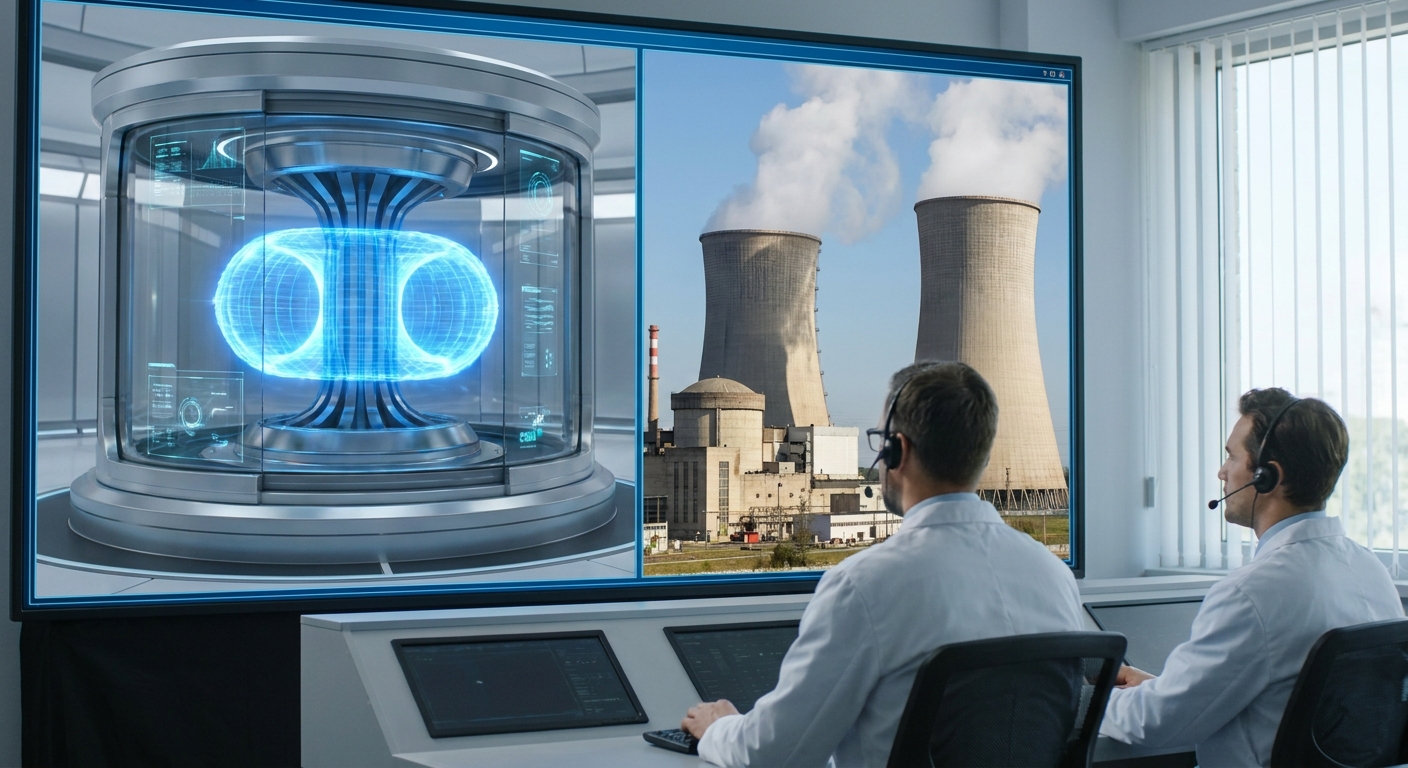
Nuclear Power Is Back on the Table — But Which Kind?
As grids decarbonize and demand spikes from AI, EVs, and electrified heating, nuclear energy is getting a second hearing.
Two very different technologies sit under the same word:
- **Fission** – Today’s reactors, splitting heavy atoms
- **Fusion** – Tomorrow’s hope, fusing light atoms
Both promise dense, low-carbon power. Their trade-offs are not the same. Here’s a direct, side-by-side look — minus marketing gloss.
---
The Physics in One Paragraph Each
Fission: Splitting Heavy Nuclei
- Fuel: usually uranium-235 or plutonium-239
- Process: neutron hits nucleus → nucleus splits → releases energy + more neutrons
- Chain reaction must be controlled by moderators, control rods, coolant
Energy release comes from **mass deficit** turned into heat (E = mc²), which boils water, drives turbines.
Fusion: Fusing Light Nuclei
- Fuel: usually isotopes of hydrogen (deuterium, tritium)
- Process: light nuclei collide at high temperature/pressure → fuse → release energy + neutrons
- Needs extreme conditions: tens of millions of degrees, strong confinement (magnetic or inertial)
Same mass-to-energy game, different side of the periodic table.
---
Maturity: Deployed vs. Demonstrated
Fission Today
- ~10% of global electricity
- ~25% of low-carbon electricity
- Hundreds of commercial reactors, multiple designs (PWR, BWR, CANDU, etc.)
Proven at scale, with decades of operational data — plus well-documented failures.
Fusion Today
- Net energy breakeven demonstrated in **short pulses** in some experiments (notably at NIF for inertial confinement)
- No grid-connected commercial reactor
- Dozens of public and private projects (ITER, SPARC, stellarators, z-pinches)
In short: fission is a **current tool**; fusion is a **R&D pipeline**.
---
Fuel Supply and Security
Fission Fuel
- Uranium is mined, processed, enriched
- Reserves are sufficient for many decades at current use, potentially longer with breeder reactors and reprocessing
- Proliferation risk: enrichment and reprocessing tech can be diverted toward weapons material
Fusion Fuel
- Deuterium is abundant in seawater
- Tritium is rare and radioactive; must be bred in the reactor from lithium using fusion neutrons
- Fuel cycle is **not yet industrialized**; tritium supply is currently tight
Proliferation risk is lower with most mainstream fusion concepts, though not zero — neutron fluxes could, in principle, be used for breeding materials.
---
Waste Profile
Fission Waste
- High-level waste: spent fuel with long-lived radioisotopes (some with half-lives of tens of thousands of years)
- Current practice: on-site storage in pools and dry casks; deep geological repositories under development (Finland leading)
- Volume is small relative to fossil waste, but **longevity and toxicity** drive public concern
Fusion Waste
- No long-lived high-level waste from fuel in standard D–T fusion
- Main issue: **activation of reactor materials** by neutrons → intermediate-level waste lasting decades to centuries
- Engineering choices (low-activation materials) can further reduce persistence
In ideal form, fusion’s waste problem is **easier but not nonexistent**. It trades long-lived isotopes for heavy neutron-activation engineering.
---
Safety and Failure Modes
Fission
Normal operation:
- Very low greenhouse gas emissions
- Routine low-dose radiation exposure for workers within regulated limits
Failure modes:
- **Loss of coolant / loss of power** → core meltdown (Chernobyl, Fukushima variants)
- Decay heat persists even after shutdown
- Requires robust containment, passive safety features, emergency planning
Modern designs (Gen III+ and advanced reactors) aim for:
- **Passively safe shutdown** (gravity-driven control rods, natural circulation cooling)
- Smaller core inventories (small modular reactors)
Fusion
Normal operation:
- High neutron flux; requires heavy shielding
- Activation of structure and tritium handling are key safety issues
Failure modes:
- Plasma disruption → reaction quickly halts; no chain reaction to run away
- Loss of confinement = **loss of performance**, not explosion
Key risks:
- Tritium leaks (a radioactive hydrogen isotope, biologically concerning in water form)
- Structural degradation from neutron damage
Net: fusion has **inherent physics limits** on runaway accidents; engineering risks concentrate on **materials, activation, and tritium management** rather than core meltdown.
---
Cost and Complexity
Fission
- Legacy large reactors: high upfront capital, long build times, cost overruns common
- Operating costs moderate; fuel cost is a small slice of levelized cost
- SMRs (small modular reactors) aim to reduce cost via **factory fabrication and standardization**, but are early-stage commercially
Real constraints:
- Regulatory complexity
- Political risk and financing cost
- Construction discipline (schedule slippage kills economics)
Fusion
- No commercial plants; cost is currently speculative
- Systems are **highly complex** (superconducting magnets, cryogenics, neutron-resistant materials)
- Private fusion startups promise competitive costs, but those are projections, not audited track records
Until a fusion plant runs on the grid and sells power at scale, economic comparisons are **rough guesses**.
---
Climate Impact and Deployment Timelines
Fission for 2030–2050
- Technology exists **now**
- New large reactors: 8–15+ years from planning to operation in many countries
- SMRs might shorten timelines if designs are standardized and regulators adapt
Fission is relevant to **near- and medium-term decarbonization**, especially where regulatory and construction ecosystems are mature.
Fusion for 2030–2050
- Most aggressive private timelines target **late 2030s–2040s** for first-of-a-kind plants, if everything goes well
- Scaling from demonstration to global fleet is another multi-decade step
Realistically, fusion is a **post-2050 scalability play** for deep decarbonization and long-term energy abundance, not a primary lever for hitting 2030 climate targets.
---
Public Perception and Political Risk
Fission
- Shadow of Three Mile Island, Chernobyl, Fukushima shapes public views
- Concerns: accidents, waste, weapons, cost
- Support can swing sharply with energy prices and climate urgency
Fusion
- Carries an aura of “clean, almost magical” in public discourse
- Few associate it with accidents or weapons
- Risk: **overpromising timelines**, leading to cynicism if targets slip
Policy reality: fission deals with **trust deficits**; fusion with **credibility and maturity gaps**.
---
Where They Might Actually Fit Together
This isn’t necessarily a cage match.
Plausible roles:
- Fission: backbone low-carbon baseload for the next 30–60 years, especially in countries that can build and regulate safely.
- Fusion: long-term complement that, if realized, could relieve pressure on land use, mining, and some waste issues.
> “We shouldn’t stall real decarbonization today waiting for perfect options tomorrow,” notes a 2022 *IPCC* contributor. “Fusion is a bet; fission is an option on the shelf.”
---
What to Watch Next
If you want signal, not hype, track:
**For fission:**
1. Actual build times and final costs of new reactors and SMRs
2. Progress on deep geological repositories and waste policy
3. Deployment of advanced reactors with **passive safety** and alternative fuel cycles
**For fusion:**
1. Demonstrations of **net electric power output**, not just physics breakeven
2. Materials that survive high neutron loads for years
3. Credible, independently reviewed **levelized cost of energy** estimates from pilot plants
4. Regulatory frameworks for tritium handling and fusion plant licensing
Both fission and fusion are tools, not ideologies. The relevant questions are brutal and simple:
- How fast can it be built?
- How safe is it under real governance, not ideal theory?
- How much does it cost per reliable kilowatt-hour?
Everything else is branding.