
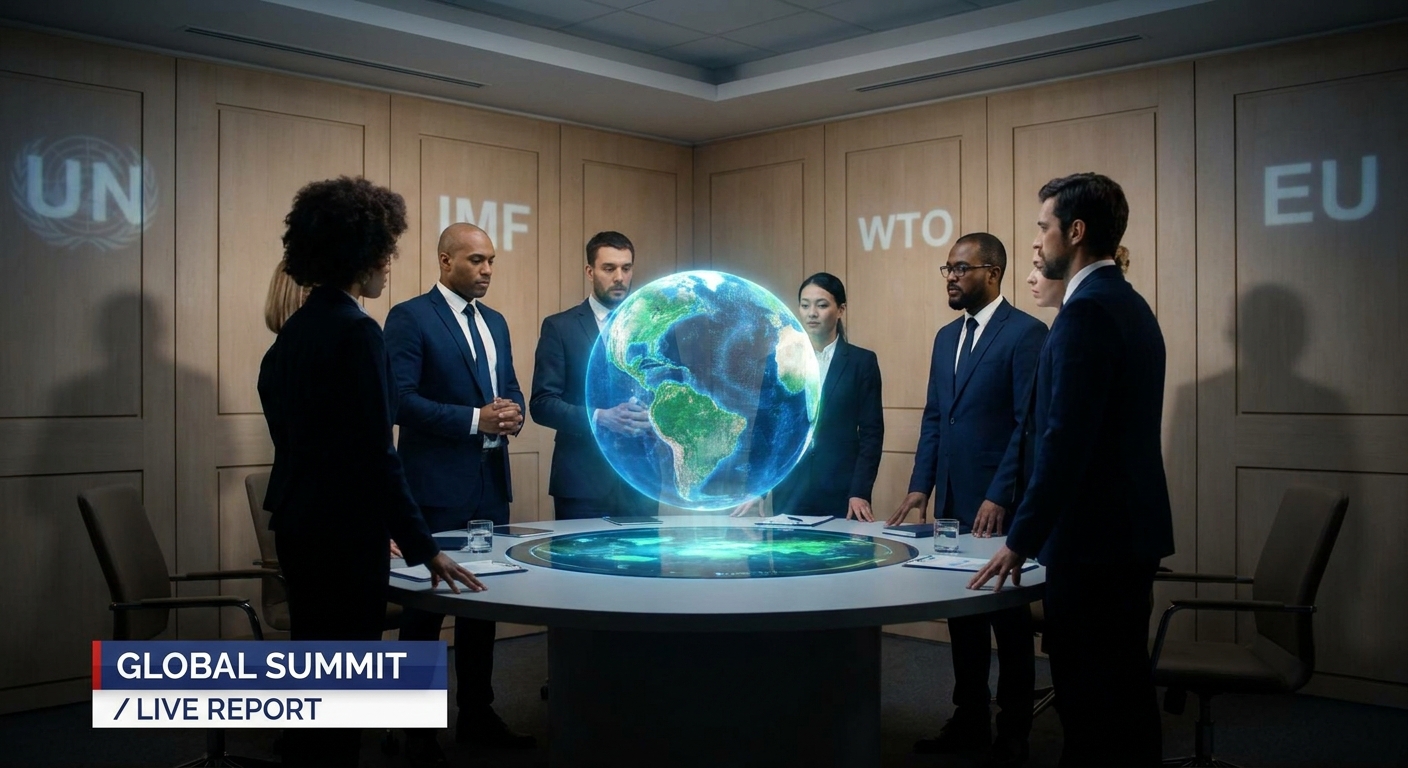
The World’s Rulemakers, Decoded
Treaties, summits, acronyms. The alphabet soup of global governance — UN, IMF, WTO, G20 — is dense by design. But these bodies quietly shape debt relief, trade rules, climate targets, and war-and-peace decisions.
This guide strips them down: what they do, who controls them, where they fail, and what to watch as global governance strains under 21st-century pressure.
---
1. The United Nations: Big Tent, Limited Teeth
**Core job:** Provide a forum for states, manage peacekeeping, coordinate humanitarian work, and set global norms.
**Power centers:**
* **UN Security Council (UNSC):** 5 permanent members with vetoes (U.S., China, Russia, UK, France) plus 10 rotating members.
* **UN agencies:** WHO (health), UNHCR (refugees), UNESCO (culture), and others.
**What it does well:**
* Legitimizes interventions and sanctions when the UNSC agrees.
* Coordinates large-scale humanitarian responses.
* Sets global goals (e.g., Sustainable Development Goals).
**Where it fails:**
* Veto power often paralyzes action on major conflicts.
* Underfunded and dependent on member-state politics.
> “The UN works best where great powers don’t care too much,” quips former UN official Sara Lindholm.
**Watch next:**
* Debates over UNSC reform (adding permanent or regional seats).
* Pressure to give more voice to Africa, Latin America, and South Asia.
---
2. International Monetary Fund (IMF): The Financial Firefighter
**Core job:** Stabilize the global monetary system, lend to countries in crisis, and advise on economic policy.
**Power centers:**
* Voting shares tied to financial contributions — the U.S. and Europe hold outsized influence.
* Managing Director (traditionally European) and Executive Board.
**What it does well:**
* Acts fast when countries face balance-of-payments crises.
* Coordinates lenders in sovereign debt restructurings.
**Where it fails:**
* Conditionality (austerity, structural reforms) often hits vulnerable populations hardest.
* Governance under-represents emerging economies.
**Watch next:**
* Rebalancing voting rights toward Asia and Africa.
* New lending tools for climate vulnerability, not just financial shocks.
---
3. World Bank: Development’s Big Checkbook
**Core job:** Finance development projects and reforms in low- and middle-income countries.
**Power centers:**
* U.S. is the largest shareholder; the Bank’s president has always been American.
* Board of Executive Directors representing member countries.
**What it does well:**
* Long-term project finance: infrastructure, education, health.
* Knowledge production on development trends.
**Where it fails:**
* Slow disbursement and heavy bureaucracy.
* Criticized for past support of projects with social and environmental costs.
> “The Bank is trying to pivot from roads and dams to climate and resilience,” notes development analyst Chinedu Okafor. “Its mandate is under renovation.”
**Watch next:**
* Expansion of climate-focused lending and guarantees to mobilize private capital.
* Tension between traditional poverty goals and new green mandates.
---
4. World Trade Organization (WTO): Referee in a Trade Fight
**Core job:** Set and enforce rules for global trade.
**Power centers:**
* Ministerial Conference (top decision-making body of all members).
* Dispute Settlement Body and now-paralyzed Appellate Body.
**What it does well:**
* Historically, provided a rules-based system that reduced tit-for-tat tariffs.
* Gave smaller countries a legal voice against major powers in trade disputes.
**Where it fails:**
* Consensus decision-making makes big updates nearly impossible.
* The dispute system has been crippled by blocked judge appointments.
**Watch next:**
* Efforts to revive or replace the dispute settlement system.
* New rules (or workarounds) on digital trade and subsidies.
---
5. G7 and G20: Steering Committees, Not World Governments
**Core job:** Informal coordination on economic and geopolitical issues.
**Power centers:**
* **G7:** Rich democracies (U.S., Canada, UK, France, Germany, Italy, Japan, plus the EU).
* **G20:** Broader mix, including China, India, Brazil, South Africa, Saudi Arabia, and others.
**What they do well:**
* Fast political coordination in crises (e.g., financial crashes, pandemics).
* Set political direction that formal bodies later implement.
**Where they fail:**
* Non-binding commitments; follow-through is uneven.
* Exclusion breeds resentment — many countries sit outside these clubs.
> “The G20 is where 21st-century legitimacy battles are playing out,” says governance scholar Miguel Santos.
**Watch next:**
* Whether G20 can deliver on debt relief, climate finance, and digital rules.
* Expanded roles for regional champions (e.g., AU, ASEAN) inside G20 processes.
---
6. Regional Bodies: Quiet Power Close to Home
Key players:
* **European Union (EU):** Single market, shared regulations, and partial shared sovereignty.
* **African Union (AU):** Political coordination, peace and security roles, and a growing economic agenda.
* **ASEAN, Mercosur, GCC,** and others with varying depth.
**What they do well:**
* Tailor solutions to regional realities.
* Create markets big enough to matter in global trade talks.
**Where they fail:**
* Internal divisions and capacity gaps can stall action.
* Limited ability to enforce decisions on reluctant members.
**Watch next:**
* The African Continental Free Trade Area (AfCFTA) rollout — potentially the largest new free trade zone.
* EU struggles over migration, defense integration, and energy policy.
---
7. The New Challengers: Clubs, Banks, and Initiatives
Emerging alternatives challenge Western-dominated institutions.
* **BRICS+** forums (Brazil, Russia, India, China, South Africa, and new entrants).
* **Asian Infrastructure Investment Bank (AIIB)** and **New Development Bank (NDB)**.
* China’s **Belt and Road Initiative (BRI)**.
Why they matter:
* Offer additional sources of finance with different conditions.
* Reflect demands for a less Western-centric order.
Risks:
* Fragmented standards on debt, environment, and transparency.
* Geopolitical competition baked into infrastructure choices.
---
Who Really Runs the World?
No single institution. Power is spread across:
* States (especially great powers and coalitions).
* Global bodies (with mandates and limits).
* Markets and platforms (Shaping behavior without formal sovereignty).
> “Global governance is more like a patchwork than a pyramid,” summarizes policy expert Leila Mansour.
That patchwork is fraying under pressure from climate shocks, digital disruption, and great-power rivalry.
---
What to Watch in Global Governance
If you want to track where the world’s rulebook is heading, follow:
1. **Representation fights:** Who gets seats and votes — especially for Africa, Latin America, and emerging Asia.
2. **New mandates:** Climate, digital, and health security mandates layered onto old institutions.
3. **Parallel structures:** Whether alternatives (BRICS banks, regional funds) coordinate with or compete against the traditional system.
The core question this decade: does the world stitch a more inclusive system — or drift into overlapping, rival architectures that struggle to manage shared crises.
Either way, the decisions won’t be made in a single building or summit. They’ll be negotiated, piece by piece, across this messy, evolving web of institutions.