
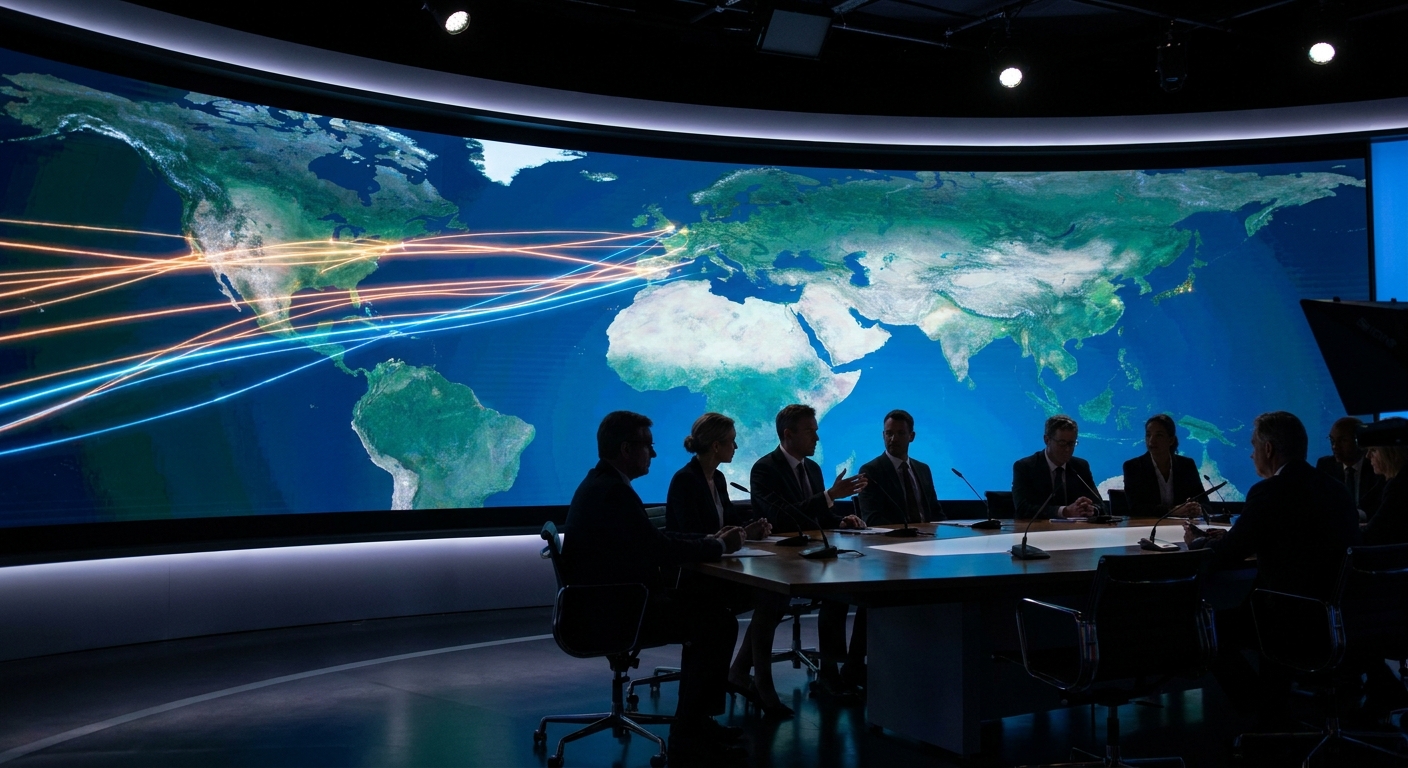
The World Is Rewiring — Fast
For decades, the world ran on a familiar script: U.S.-led order, expanding globalization, and relatively clear lines between allies and rivals. That script is being ripped up.
Great-power rivalry is back, supply chains are political weapons, and climate, tech, and demographics are reshaping who holds leverage. Understanding this new map of power isn’t academic — it affects prices, jobs, elections, and security everywhere.
This explainer cuts through the noise: who’s rising, who’s stalling, and what to watch as the global balance tilts.
---
The Old Order: What’s Breaking
From the 1990s through the 2010s, the global order had three pillars:
1. **U.S. dominance** in security and finance (dollar primacy, military reach, tech leadership).
2. **Globalization at full speed** — firms chasing cheap labor and open markets.
3. **Assumptions of convergence** — the belief that countries integrating into the global economy would liberalize over time.
Those assumptions are now under sustained pressure.
> “We’re not watching the ‘end of globalization,’ but we are seeing the end of its naïve phase,” says Dr. Lina Ortega, a political economist at the London School of Economics. “Security, resilience, and ideology are firmly back in the driver’s seat.”
---
New Poles of Power: Beyond a U.S.–China Binary
The headlines focus on the U.S.–China rivalry, but the real story is more multipolar and messier.
1. The U.S.: Still First, But Not Uncontested
* **Strengths:** Dollar dominance, unmatched alliance network (NATO, Indo-Pacific), world-leading tech and capital markets.
* **Weaknesses:** Political polarization, fiscal pressures, and war fatigue.
The U.S. remains the system’s central node, but its ability to set rules uncontested is gone.
2. China: Ambitious, Powerful, and Boxed In
* **Strengths:** Manufacturing powerhouse, scale in tech adoption, state-directed investment.
* **Constraints:** Aging population, property-sector stress, and pushback from neighbors and Western economies.
China’s Belt and Road Initiative and defense buildup have rattled rivals and pulled partners closer — and also provoked counter-coalitions.
3. The Middle Powers: Quietly Critical
Countries like India, Brazil, Indonesia, Turkey, South Africa, and the Gulf states increasingly swing outcomes.
* They hedge, instead of taking sides.
* They leverage competition between great powers for better trade, energy, and security terms.
> “Middle powers are no longer spectators,” notes Anil Deshmukh, a former Indian diplomat. “They’re auctioning their alignment to the highest strategic bidder.”
---
The Three New Battlefields of Global Power
1. Supply Chains as Weapons
Semiconductors, rare earths, batteries, and critical minerals are now geopolitical chokepoints.
* Export controls on advanced chips limit rivals’ tech growth.
* Countries are onshoring or “friend-shoring” supply chains.
* Trade pacts are judged by resilience, not just efficiency.
When a single factory shutdown can ripple through global auto or electronics production, logistics becomes strategy.
2. Energy and Climate as Levers
Fossil fuel exporters and green-tech leaders are both gaining leverage.
* OPEC+ decisions still sway inflation globally.
* Countries controlling lithium, cobalt, and nickel are bargaining harder.
* Solar, wind, and nuclear strategies are now security conversations, not just climate debates.
> “The energy transition doesn’t depoliticize resources; it repoliticizes different ones,” says Dr. Farah Klein, an energy analyst in Berlin.
3. Information and Technology Wars
Who sets the standards for AI, 5G, payment systems, and data flows will shape the next 30 years.
* Competing digital ecosystems (U.S.-aligned vs. China-aligned) are emerging.
* Data localization laws are fragmenting the internet.
* Disinformation campaigns blur domestic and foreign policy.
Tech is no longer a neutral platform — it’s the terrain of geopolitical competition.
---
Why This Shift Matters to You
This isn’t abstract diplomacy. The new geopolitics hits daily life:
* **Inflation and prices:** Sanctions, tariffs, and supply-chain rerouting raise costs.
* **Jobs:** Manufacturing relocation and tech restrictions shape where factories and data centers go.
* **Security:** Flashpoints over Taiwan, the South China Sea, Eastern Europe, and the Middle East risk broader conflict.
* **Digital rights:** Where your data is stored — and under whose laws — depends on which digital bloc your country leans toward.
When the world fractures, households pay attention.
---
Three Fracture Lines to Watch
1. U.S.–China: Competition with Guardrails?
The core question: does this rivalry stay below the threshold of war?
Watch for:
* Agreements on crisis hotlines and military-to-military communication.
* Escalations over Taiwan and the South China Sea.
* Tech sanctions and countersanctions spreading to new sectors.
2. The Global South’s Bargaining Power
The “Global South” isn’t a bloc, but its leverage is rising.
Key signals:
* How India positions itself in tech, defense, and trade deals.
* Whether African and Latin American states negotiate better terms for mineral extraction.
* Voting patterns at the UN on sanctions, wars, and recognition issues.
3. Currency and Financial Fragmentation
The dollar is still dominant, but others are probing alternatives.
Look for:
* More bilateral trade in local currencies.
* Expansion of non-Western payment systems and development banks.
* Subtle shifts in central bank reserves toward gold and non-dollar assets.
> “We’re not in a ‘post-dollar world,’” clarifies currency strategist Mei Tan, “but we are in a world where some countries are experimenting with ‘less dollar’ over time.”
---
What Endures Amid the Upheaval
Despite the turmoil, a few realities persist:
* **Interdependence isn’t going away.** Decoupling is partial, expensive, and selective.
* **Alliances still matter.** Countries with reliable partners generally weather shocks better.
* **Demographics and innovation decide long games.** Population age structures and R&D pipelines outlast headlines.
The map is tilting, not flipping.
---
The Bottom Line
The world is shifting from a single-center model to a crowded chessboard of competing powers and interests. Great-power rivalry, weaponized supply chains, and tech standards battles are no longer background noise; they’re the soundtrack.
For citizens, businesses, and policymakers, the assignment is the same: stop assuming yesterday’s order will enforce tomorrow’s rules. Watch where capital, talent, and alliances actually move — that’s where the new map of power is being drawn.